Showing posts with label Visual Illusions. Show all posts

Tuesday, May 14, 2013

Cool Visual Illusions: Flashed Face Distortion Effect


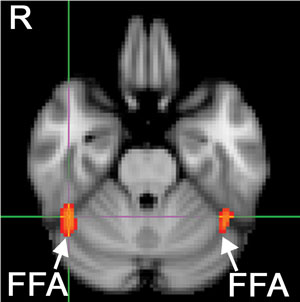
As a highly social species, recognizing faces, and the expressions on them, is pretty important to us. It's so important, in fact, that our visual systems have areas primarily devoted to faces (e.g., the fusiform face area, shown in the picture on the left). As a result, we're pretty good at it. Researchers are still trying to figure out exactly how we do it well, but that we do it well, and that our brains treat faces as special, is certain.

One thing researchers do know is that features like the nose, eyes, and mouth, and their configuration (their size, position, and relationship to each other) are important. A recently (and accidentally) discovered facial illusion makes the importance of features clear:


I recommend watching the video twice. The first time, follow the instructions at the beginning and keep your eyes on the cross in the center. Then watch it again, looking at one or the other of the faces directly. Freaky, right?
 
The discoverers of this illusion, Tangen et al. (you can read their paper here, or their short post on the illusion here), suggest that's what happening here is that, when the faces begin to scroll, we process the features of one face relative to the features of the next face, which causes both our perception of the features themselves and their configuration to become distorted. In a sense, our brains don't realize that the different features belong to different faces, so they create horribly distorted faces as a result.

Oh, and they also have a celebrity version:

Monday, May 6, 2013

Penrose Triangle Meets Kanizsa's Triangle

Everyone knows Penrose triangle (image from here). It is one of many impossible objects that result from our visual system interpreting a possible 2-dimensional figure as a 3-dimensional impossible one. Last week I talked about Kanizsas triangle, an illusion in which our brains are tricked into perceiving contours where none exist. Christopher Tyler of the Smith-Kettlewell Institute has produced an image that combines the two.

To do so, he took a basic, though pretty cool looking version of Kanizsa's triangle (Tyler's original image with the white lines removed):


And added 3 white lines, to produce this (his original image):


The white lines produce a depth effect which makes the triangle appear 3D, and therefore impossible, as in the Penrose triangle. It took me a minute to get the effect, so look again if you don't see it the first time. I find it's best if you look just off center (e.g., at the center of the top left circle).

This illusion was one of the finalists in the 2011 Illusion of the Year contest (you can see a larger version of the image there).


Tuesday, April 30, 2013

Kanizsa's Triangle: Illusory Contours and the Inferring of the Perceptual World

Since I said a little bit about the title of the blog, I figure I'd say a bit about the image in the banner as well. It's a "Rubin Vase," a "bi-stable" image (sort of like a necker cube, a duck rabbit, or the "Old Woman-Young Woman") in which our brains alternate which part is the figure, and which part is the ground, so that at times it appears as a vace, and at times it appears as two faces, (usually) without us seeing both at the same time. Now, since I'm lazy, and since it's unlikely anyone's reading this anyway, I'm not going to talk about the Rubin's Vase, because to explain it would require a detailed explanation of figure-ground processing, as well as facial recognition (our brains have special areas just for faces, and it turns out the Rubin Vase activates those areas). That's just too much work. But I included the image in the banner because I dig visual illusions, so instead I'll talk about a (comparatively) simpler one, and maybe someday get to Rubin's.

My thing, my groove you might say, in the study of the mind is all about the ways in which our brains build our world, and how little “we”, by which I mean our conscious selves, have any say in it. At higher, cognitive levels, heuristics and biases, unconscious processing, and “hot” reasoning – that is, affect or emotion-driven reasoning – do the bulk of the work in ways that we're all familiar with (if you don't know what I'm talking about, get into an argument on the internet and watch these biases, “hot” processes, and all the other unconscious ways in which we build the world play out in virtual time). At a lower level, though, visual illusions reveal even more interesting, and perhaps frightening, ways in which our brains build our perceptual world. They show that we don't simply take in reality and represent it as it is out there, independent of us. Instead, we meet it with a bunch of built in assumptions and rules of inference that, when conditions are right, cause us to mis-see things out there.